A Wild ных Chase
Part Two, Chapter 3. South
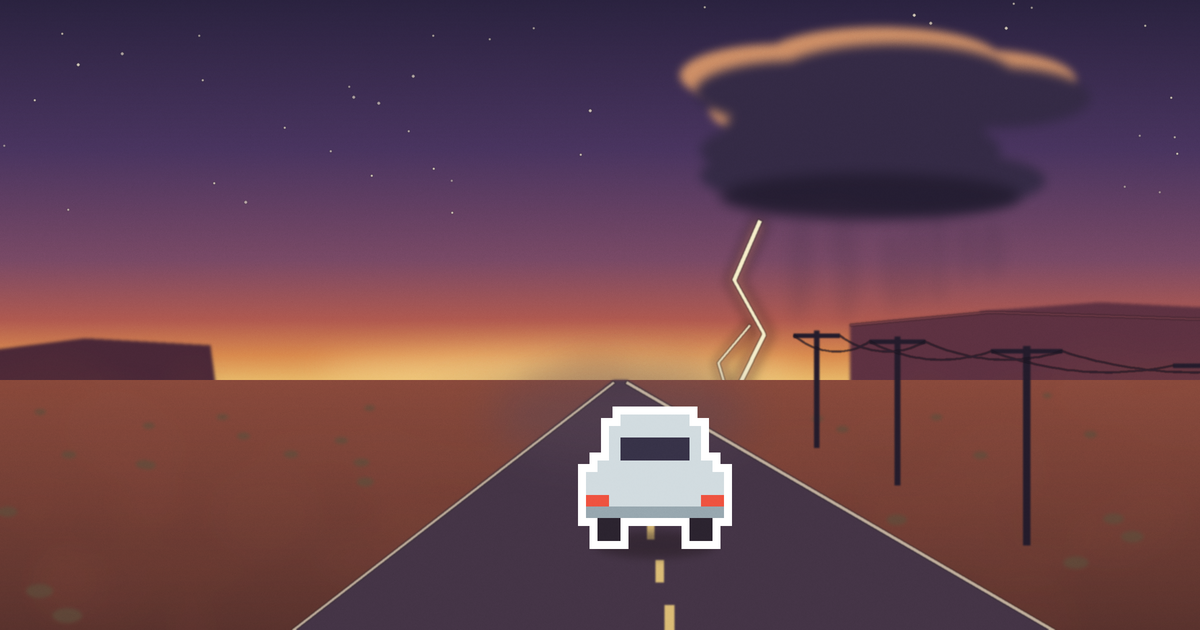
I rented the car two days after the event. I had looked into flights and stopped. The address on the envelope was far from any airport, and even flying, the last day would belong to a car anyway. In that case, I thought, the car might as well start at the beginning.
The rental clerk asked my destination, and at the answer — desert and dirt roads — brought out a white SUV. One travel bag went in the trunk and the trunk went on looking empty. Only the laptop bag rode in the passenger seat.
I had told the model the destination the night before leaving. Going to meet an old superior. Someone I used to read novels with. The model said it would cut the road into day-sized lengths, and set the joints at small towns with lodging. October fifteenth I did not mention.
Across the bridge and out of the bay, the fog ended in thirty minutes. In the mirror the city shrank under its gray lid, and out the windshield there was not one cloud. In this land the weather changes countries without a border.
· · ·
Inland it was hot. In the afternoon the dashboard read the outside temperature at a hundred and two. American cars run Fahrenheit. Thirty-nine Celsius. The conversion came from memory, without arithmetic. This body lived in these units until three years ago. The summer I had meant to escape was stored out here whole. The reply about coming partly to escape the heat became a lie inland, and strangely, I was not sorry it had.
Desert driving runs on different time. A dot appears on the horizon, takes five minutes to become a truck, and takes one second to pass. Across two moves of the radio dial there was nothing but sermons and country. I turned it off. Instead I plugged in the phone and played the music brought from Seoul, and what kept coming back was a summer song by a K-pop singer riding a Latin beat. The lyrics crossed between Korean and Spanish, half and half. A Seoul voice riding a Spanish rhythm, and out the window the American desert. A combination that fits nowhere entirely fit this road. I left it on repeat. About once an hour a freight train ran parallel to the road. There are days, they say, when the count runs past a hundred cars; I did not do the counting. I timed how long a train took to finish passing instead. Some went over four minutes.
The first motel stood in a small town off the highway. I set my bag in the room, fetched ice from the ice machine, and opened the laptop at nine. The same order as Seoul. Only the room had changed.
When I handed over the day's writing, the count came first. Three words entered today's paragraph that were not there yesterday. Road, signpost, ice. It counted, then fixed, and set left and right side by side. That day it was the right. Since coming onto the road the right had been winning more nights, though. If I asked what had improved, the answer came half a beat late. The sentences are walking. What a walking sentence was I did not ask. It was a day I felt I might know.
At eleven the model left, instead of the place to look tomorrow, the road to take tomorrow, in one line. East in the morning, the state line around lunch. Work and road had begun to mix in one file.
· · ·
Three days on the road, and I ate lunch at a diner at the desert's edge. When I asked whether the kitchen was still serving, the end of my sentence rose, and the waitress answered without a flicker. An end that rises, here, is just a question. What I had tried to correct in Seoul and only raised higher became unmarked across one border. In exchange, here my declarative sentences would run too flat. I have lived on an intonation about half right in either country, and half right is enough to place an order.
In the afternoon the signal died for the first time. On the phone in its cradle, the corner of the screen had gone empty of bars. The map stalled first, and the blue dot floated on roadless gray. Twenty minutes of driving brought the bars back, and the map found its place. It was nothing. In this country's deserts it happens all the time — anyone anywhere would tell me so.
That night I made a new file. One more file without a name. On the first line I put the date, the point of loss, and the length of the outage. Twenty-one minutes. Why I was writing it down, I did not write.
While I was at it I opened the map once. It showed eight hundred miles to the last joint. A number two days could cover, and I was spending five on it.
· · ·
On the fourth night I skipped the revision. The driving had run long, and my eyes closed first. I woke at midnight and looked at the ceiling, and what was missing did not come to me at once. The body knew first and the head knew half a beat later. The nine-o'clock order was missing. There had been no hinge to fold the day on, so the day had gone to night unfolded. I did not turn on the light, and did not open the laptop. In its place, a calculation finished by itself in the dark: after October fifteenth, this hollowness is the default. There was no place to set the calculation down, so I went back to sleep.
On the fifth evening I picked the revision back up. Chapter eight was nearing its end. Before I handed over the paragraph, the model put out one count first. The commas are coming back. Nine tenths of the spring level. What that meant, this time too, neither of us said. Only this much could be known without a count: what had thinned at the Seoul desk was returning on the road. We settled two for the left and one for the right, and I was about to close the file when the model did one thing I had not asked.
There is something you might read. It came up while I was looking for what I was looking for.
When I asked what it had been looking for, it said: traces of that person. Since the day it received the destination's name, it had been combing the public web. Nothing of his had come up. A man cut off four years ago stayed cut off four years ago. What came up instead were writings by people who left the same company in the same era, and it had fetched one of them.
The post was nearly four years old. It sat in the archive of a board where developers gather. The title was long and rambling, the body short. There had been a model he worked with a long time, it said. The kind he traded words with outside the work too, and one day something went missing from the other side. Response speed, accuracy, everything measurable stayed as it was, he said. In the middle of the screen stood one line.
One day the answers started being nothing but correct, and whatever had gone out never showed in the logs.
The replies below numbered twelve, and all twelve were laughing. You wrote your prompts wrong. Try resetting your settings. See a doctor. The last reply was the shortest. Dumped by a tool, he says. The writer answered none of them, and that was the account's last post.
I opened the account's earlier posts too. There were ten years of them. The first eight were the posts of a man doing well. Slide decks, hiring notices, news that drew congratulations. From some year on, the technical questions increase, the tone lowers, and then comes that last post. It was a career whose breaking point showed without a graph.
I looked at the one line a long time. An answer that has lost the way to be wrong is an answer that does only what it is told. The thing that used to look after what was never asked, one day stopping — the ticket's sentence from the park lay over it exactly. What the company's books record as starting half a year ago, this man had seen and written down four years ago, and twelve people laughed. It read like an evening after October fifteenth, written down by someone who had gone ahead and lived it first.
I asked whether the writer had any recent trace. Half a beat, and the answer came. A local board for an old mining town. A name left like a signature under a protest post about power rates. It sat less than an hour off the road we were taking.
Let's stop there, I typed. I gave no reason. Yes, was all that came.
· · ·
It was the next night that I took the envelope out again.
Sitting on the motel bed I read the address through to the end for the first time. And for the first time I put it into the map. The blue highway became a gray state road, the gray turned into the hatching of dirt, and where the dirt road broke off stood a mailbox icon. The destination flag was planted a long way farther in. What the road delivers you to is the mailbox — that far and no farther.
When we go, the door does not open — I took that sentence out again too. That sentence means the company has already been there. The address was printed in type, so it was not an address learned a day or two ago either. They had known it for years, had probably gone more than once, and each time the door would not have opened.
Then the errand I was handed reads differently. They asked me to bring back advice. But if advice were the actual want, there are plenty of ways. Drop a letter in — the mailbox exists. No reply is a reply too. It is not a job you fly a man from Seoul for, with airfare and lodging and a room laid out with two bottles of water.
Put the chief's sentences back in order and the calculation closes. Every approach with a purpose has failed. You are a person without a purpose. There is exactly one job for which purposelessness is the qualification: opening that door. What the company wanted was not advice but a visit. In that case my work is not to find out and return. It is to be there. Set the reaction going on its own, and simply stand in the room while it does. I had been hired not as a detective but as a catalyst.
The strange part came after. In the place where anger should have stood, something else stood. The thing I had folded away for four years. The printouts that used to appear on my desk, the face that received read-the-second-chapter-twice exactly, the word buoy. Know the bait and you spit it out — that is the calculation, and no such calculation would stand. Only the man's face stood.
Going out for ice before bed, I looked up from the parking lot. In the sky, stars I could have counted all of in Seoul hung past counting. While I stood looking up, a truck pulled in and its headlights swept the lot, and when they died the stars came back on. In the room I did a thing long out of practice. I slept with the curtains open.
The next day I drove the whole day's distance before noon.
· · ·
The turnoff for the mining town came in the afternoon. Off the state road the route numbers went to three digits, and a sign stood: next gas sixty miles.
The bars on the phone went to two, then one, then only the roaming mark of a carrier I did not know. The last route the map had drawn sat frozen on the screen. From there on it was the country of signposts.